
How Consumers Really Feel About Agentic Commerce: What AI-Assisted Purchasing Means for Trust and Conversion

As part of our ongoing research into how app marketers adapt to an evolving landscape of technology, data, and strategy, Bidease surveyed 100 UA marketers to uncover what’s really changing behind the scenes. Each post in this series highlights one insight shaping the future of programmatic growth, straight from the marketers driving it.
AI-powered features began as experimental add-ons and have evolved into deeply embedded elements across the consumer app ecosystem. From "For You" feeds on TikTok to Amazon’s Rufus, AI has shifted from a novelty to a critical infrastructure that shapes discovery, support, and spending. As we move into 2026, the market is pivoting toward "Agentic AI," systems that don't just recommend products but actively guide decisions, build baskets, and assist with checkout. This shift is massive: global AI-enabled e-commerce sales are projected to reach $8.65 billion in 2025, with agentic shoppers expected to influence up to $385 billion in U.S. e-commerce sales by 2030.
However, this transition forces product and marketing teams to confront a “trust gap." After all, agentic AI is a relatively fresh face, and it takes time to build trust among consumers. To understand this nuance, we surveyed 100 consumers across various demographics in the United States regarding their use of AI-driven features in finance, shopping, and entertainment. The goal was to move beyond the hype and uncover the specific conditions that determine whether a user hits "buy" or abandons the cart.
How Consumers Feel About AI Personalization in Apps
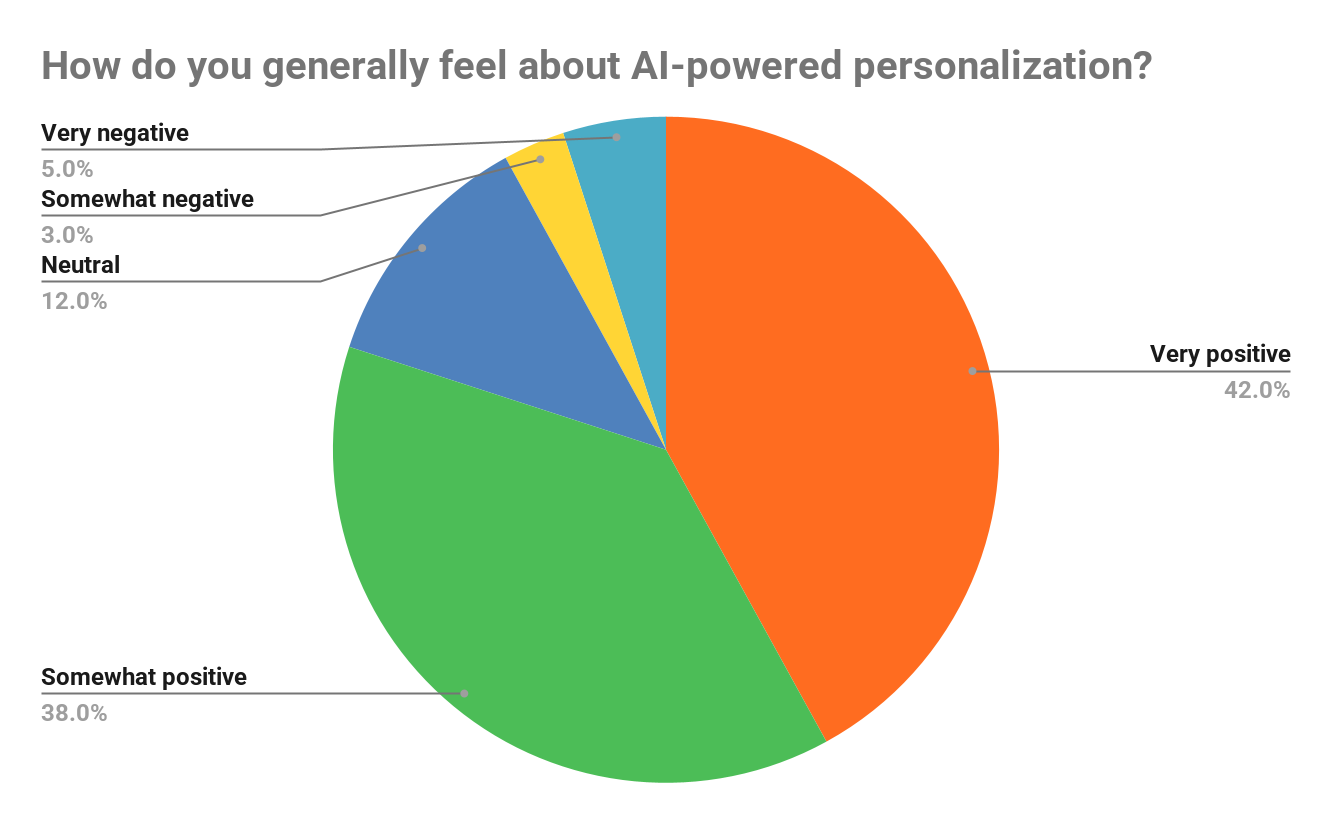
Consumer sentiment toward AI personalization is overwhelmingly optimistic, contradicting the narrative of a widespread "techlash." Our survey data shows that 80% of respondents view AI personalization positively, with 42% stating it makes apps "very positive" and useful. This aligns with broader market trends where personalization drives measurable revenue lift; Salesforce notes that 73% of customers expect better personalization as technology advances.
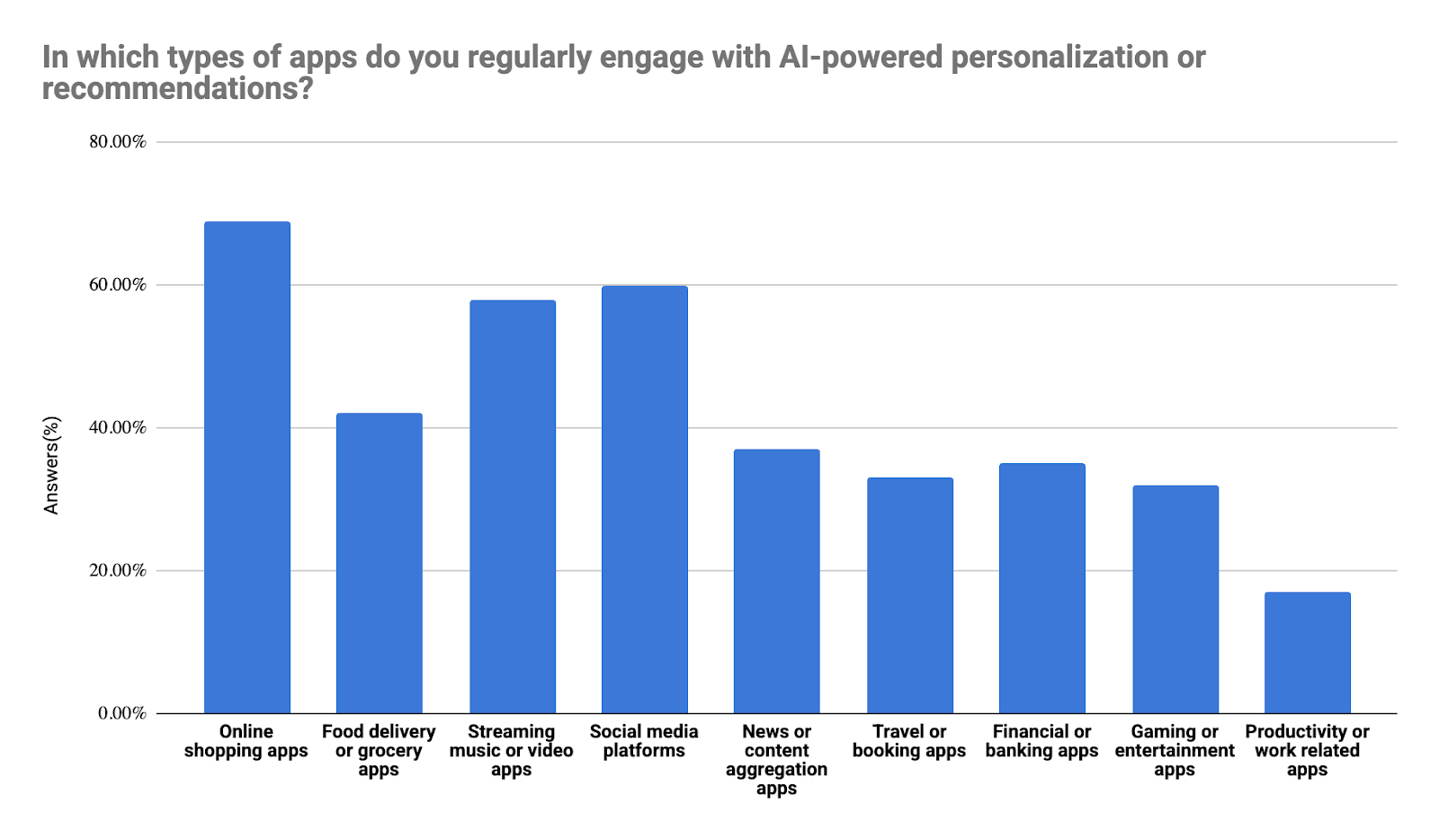
However, this optimism is strictly utilitarian. When asked about the primary benefit of AI-powered personalization, the top response wasn't "discovery" or "novelty", it was "saves me time" (32%). Users engage most heavily with these features in online shopping apps (69%), surpassing even social media (60%) and streaming (58%). This signals that for mobile users, AI is valued primarily as a friction remover. They want efficient retrieval, not just "smart" suggestions.
Yet, acceptance has a hard ceiling: privacy. Our data indicates that personalization feels intrusive when the mechanism becomes opaque. The top friction point, cited by 49% of users, is when AI uses "personal or sensitive data," followed closely by the uncanny valley feeling that the AI "knows too much about me" (40%). This mirrors external findings where 81% of users say the risks of data collection outweigh the benefits. In short, consumers aren’t jumping to tell agentic AI their deep dark secrets. They want AI assistants to operate like an assistant, with a significant degree of skepticism where personal information and financial details are concerned.
Trust Changes When AI Influences Purchasing Decisions
We can see this skepticism take root when AI moves from passive content curation to active commerce. While traditional algorithms rank and sort, agentic AI introduces actions, sequencing, and suggestions at key purchasing moments. And while thoughtful suggestions can have a positive impact on the consumer experience, no one likes to be strong-armed.
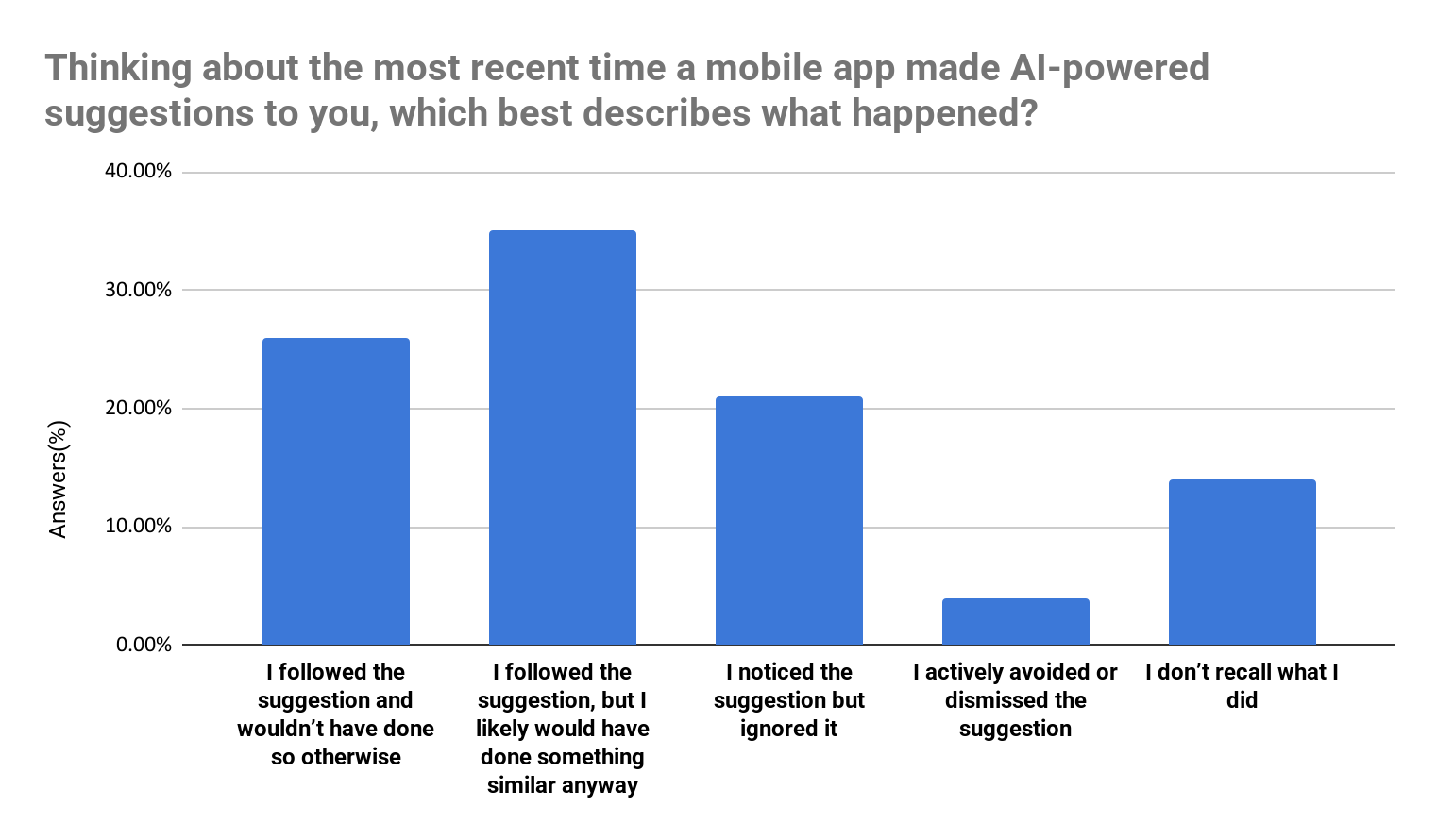
Our research shows that AI is currently more effective at accelerating intent than creating it. When analyzing the last time an app made an AI suggestion, 35% of users reported they followed the suggestion but "likely would have done something similar anyway." This suggests AI acts as a powerful lubricant in the conversion funnel, helping users complete tasks they already intended to do. However, there is a significant growth opportunity: 26% of users followed a suggestion and "wouldn't have done so otherwise," representing net-new engagement driven entirely by the algorithm.
Despite this potential, the "agentic" aspect can trigger hesitation. Our qualitative feedback reveals that users ignore suggestions that feel "insincere" or when they "already knew what [they] wanted." In the high-stakes environment of ecommerce, an incorrect prediction is a conversion blocker. If the AI introduces friction by trying to override strong user intent with irrelevant suggestions, trust evaporates.
What Drives Trust in AI Powered Experiences?
As mobile marketers introduce more complex, agentic experiences, the data suggests that trust is not built by making the AI smarter, but by putting the user in the driver’s seat.
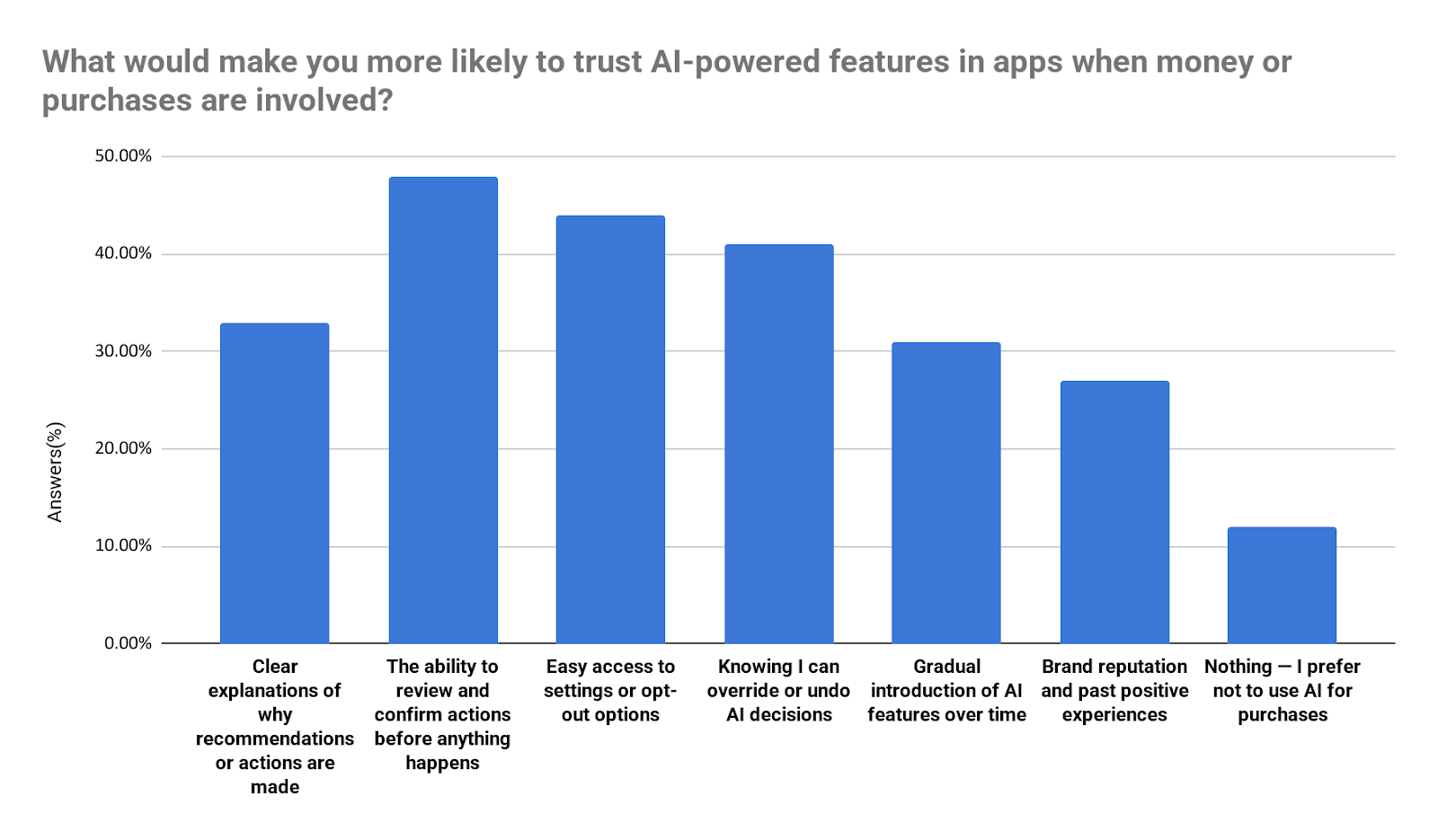
When asked what would make them trust AI features involving money, the results were definitive:
- 48% require the "ability to review and confirm actions before anything happens."
- 44% want easy access to "settings or opt-out options."
- 41% need to know they can "override or undo AI decisions."
Consumers are willing to let AI handle the heavy lifting of product selection and comparison. Indeed, 46% of business buyers would work with an AI agent for faster service, but they demand a "human-in-the-loop" architecture for the final execution. Our qualitative data reinforces this; users reported following AI advice when it appeared "logical," "time-saving," or "superior to [their] own research.” This is why phrases that imply autonomy ("We picked this for you") may be less effective than those that imply assistance ("Here are options based on your preferences").
Our data shows that 31% of consumers prefer a "trust ladder" approach for AI integration, especially regarding financial decisions. Instead of a sudden transformation, apps should first deploy AI in low-risk discovery zones like search or content feeds. Once the AI’s relevance is proven, you can introduce optional "agentic" assists in high-stakes areas like checkout. By establishing value during browsing before requesting control over buying, you avoid the friction of an algorithm moving too fast.
Trust declines rapidly when the "why" behind a decision is invisible; users need to see the logic to sign off on a purchase. This requires shifting AI from using prescriptive language like "buy this" to demonstrative language like "we suggest this because it matches your previous search.” When an app surfaces the underlying reasoning, it provides the final piece of evidence a user needs to move from cautious browsing to a confident checkout.
Trust Shapes the Pace of AI Adoption in Apps
Consumers are open to AI-powered commerce, but only when the boundaries are clear, they have agency, and the utility is undeniable. Our survey data confirms that while users value the time-saving capabilities of AI, they are resistant to features that feel like a "black box."
For mobile growth marketers, the path forward lies in calibration. E-commerce and finance apps that successfully balance AI autonomy with user agency—providing "kill switches," confirmation screens, and clear logic for recommendations—will see higher adoption rates and deeper trust. As the era of agentic commerce unfolds, the difference between a browsing user and a buying customer comes down to precision, transparency, and trust.
Achieving this level of precision requires an acquisition partner that doesn't just deliver impressions, but identifies the high-intent users ready to engage with these AI-powered features. Bidease leverages proprietary neural networks to find and acquire your most valuable customers across the mobile ecosystem. By combining full-funnel transparency with data-driven programmatic technology, we help you scale your growth strategy without the "black box" guesswork. Contact us today.

Customer retention is the key
Lorem ipsum dolor sit amet, consectetur adipiscing elit lobortis arcu enim urna adipiscing praesent velit viverra sit semper lorem eu cursus vel hendrerit elementum morbi curabitur etiam nibh justo, lorem aliquet donec sed sit mi dignissim at ante massa mattis.
- Neque sodales ut etiam sit amet nisl purus non tellus orci ac auctor
- Adipiscing elit ut aliquam purus sit amet viverra suspendisse potent
- Mauris commodo quis imperdiet massa tincidunt nunc pulvinar
- Excepteur sint occaecat cupidatat non proident sunt in culpa qui officia
What are the most relevant factors to consider?
Vitae congue eu consequat ac felis placerat vestibulum lectus mauris ultrices cursus sit amet dictum sit amet justo donec enim diam porttitor lacus luctus accumsan tortor posuere praesent tristique magna sit amet purus gravida quis blandit turpis.

Don’t overspend on growth marketing without good retention rates
At risus viverra adipiscing at in tellus integer feugiat nisl pretium fusce id velit ut tortor sagittis orci a scelerisque purus semper eget at lectus urna duis convallis porta nibh venenatis cras sed felis eget neque laoreet suspendisse interdum consectetur libero id faucibus nisl donec pretium vulputate sapien nec sagittis aliquam nunc lobortis mattis aliquam faucibus purus in.
- Neque sodales ut etiam sit amet nisl purus non tellus orci ac auctor
- Adipiscing elit ut aliquam purus sit amet viverra suspendisse potenti
- Mauris commodo quis imperdiet massa tincidunt nunc pulvinar
- Adipiscing elit ut aliquam purus sit amet viverra suspendisse potenti
What’s the ideal customer retention rate?
Nisi quis eleifend quam adipiscing vitae aliquet bibendum enim facilisis gravida neque euismod in pellentesque massa placerat volutpat lacus laoreet non curabitur gravida odio aenean sed adipiscing diam donec adipiscing tristique risus amet est placerat in egestas erat.
“Lorem ipsum dolor sit amet, consectetur adipiscing elit, sed do eiusmod tempor incididunt ut labore et dolore magna aliqua enim ad minim veniam.”
Next steps to increase your customer retention
Eget lorem dolor sed viverra ipsum nunc aliquet bibendum felis donec et odio pellentesque diam volutpat commodo sed egestas aliquam sem fringilla ut morbi tincidunt augue interdum velit euismod eu tincidunt tortor aliquam nulla facilisi aenean sed adipiscing diam donec adipiscing ut lectus arcu bibendum at varius vel pharetra nibh venenatis cras sed felis eget.
Related articles
Browse all articles


Let's Talk
We're Here to Help
Start your free consultation today. Create a custom growth strategy with a Bidease specialist.