
The Pinterest Growth Model: Why Micro-Moments Are Worth More Than Macro-Trends

As part of our ongoing research into how app marketers adapt to an evolving landscape of technology, data, and strategy, Bidease surveyed 100 mobile UA marketers to uncover what’s really changing behind the scenes. Each post in this series highlights one insight shaping the future of programmatic growth, straight from the marketers driving it.
For the last decade, performance marketing has been focused on identity, knowing exactly who a user is to serve them an ad. But as privacy regulations upend the signals that made identity targeting possible, the industry is finding new, prediction-powered ways to deploy ads to the right audiences. This isn't just about guessing what's cool. Pinterest Predicts 2026 report, which forecasts trends ranging from "Gimme Gummy" aesthetics to "FunHaus" decor, boasts an 80% historical accuracy rate. Why? Because they don't look at what people did, they look at what people are searching for.
Our research reveals a critical shift in how growth teams are applying this logic. Marketers increasingly see more value in "micro-moments"—the immediate intersection of search velocity, weather, and time—than in broad, slow-moving macro-trends. While macro-trends provide a backdrop, it is the micro-moment that drives conversion in a privacy-first world. To understand this transition, we surveyed mobile growth marketers and advertisers regarding their use of internal data, contextual signals, and predictive modeling.
Micro-Moments Reign Supreme
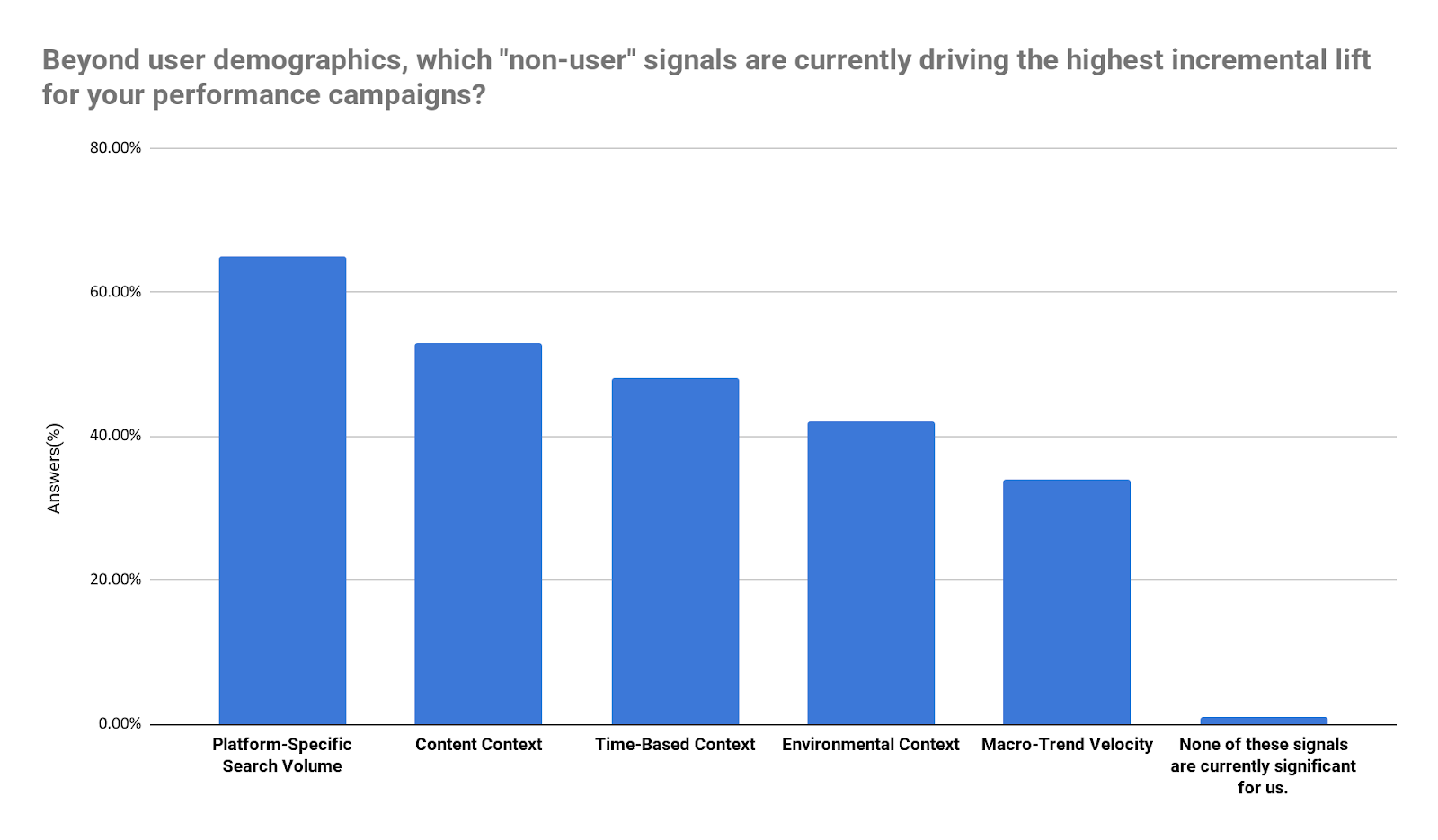
When we analyzed which non-user signals drive the highest incremental lift, specificity and immediacy won out over broad themes. The top signal, cited by 65% of respondents, was "Platform-Specific Search Volume," knowing exactly what keywords are spiking on platforms like TikTok or Pinterest right now. This significantly outperformed "Macro-Trend Velocity" (34%). Marketers are finding that the immediate context of content (53%) and time (48%) predicts conversion probability with far greater accuracy than broad cultural waves. This data proves that the modern growth stack is being built around micro-moments: the precise instant where intent meets opportunity.
A prime example is Foodpanda, a global food delivery app which leveraged Bidease's predictive contextual capabilities to scale user acquisition. Rather than relying solely on broad demographics, the campaign utilized time-based contexts (targeting users during lunch and dinner hours) and hyper-local weather signals. By aligning ad delivery with the specific "micro-moments" of hunger and unwillingness to brave bad weather, Foodpanda achieved a 3.68% Android conversion rate and a 16.93% iOS conversion rate, smashing the 3% and 8.5% conversion rate KPIs they’d set for the campaign, respectively.
The Renaissance of Contextual Targeting
The industry is currently divided between defaulting to platform automation and actively building new intelligence layers. While 31% of respondents are leaning heavily into broad targeting—letting Meta and Google handle optimization entirely—a statistically significant 28% are taking an alternate approach, "increasing investment in contextual intelligence tools" to replace lost signals.
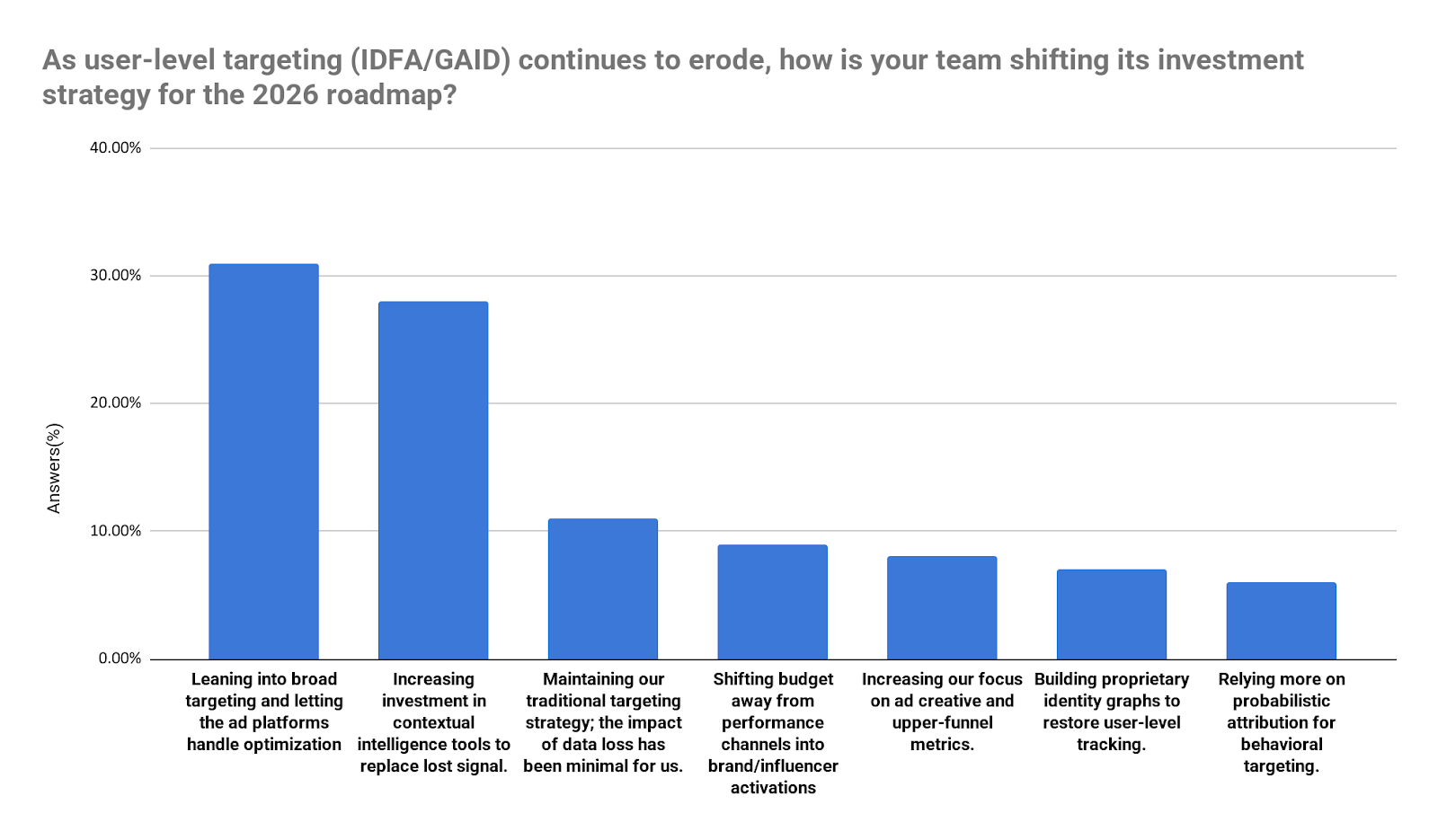
This divergence signals that for nearly a third of the market, "walled gardens” are insufficient. These teams are attempting to replicate the "Pinterest Model" within their own stacks, seeking to regain control by layering contextual data on top of broad programmatic execution.

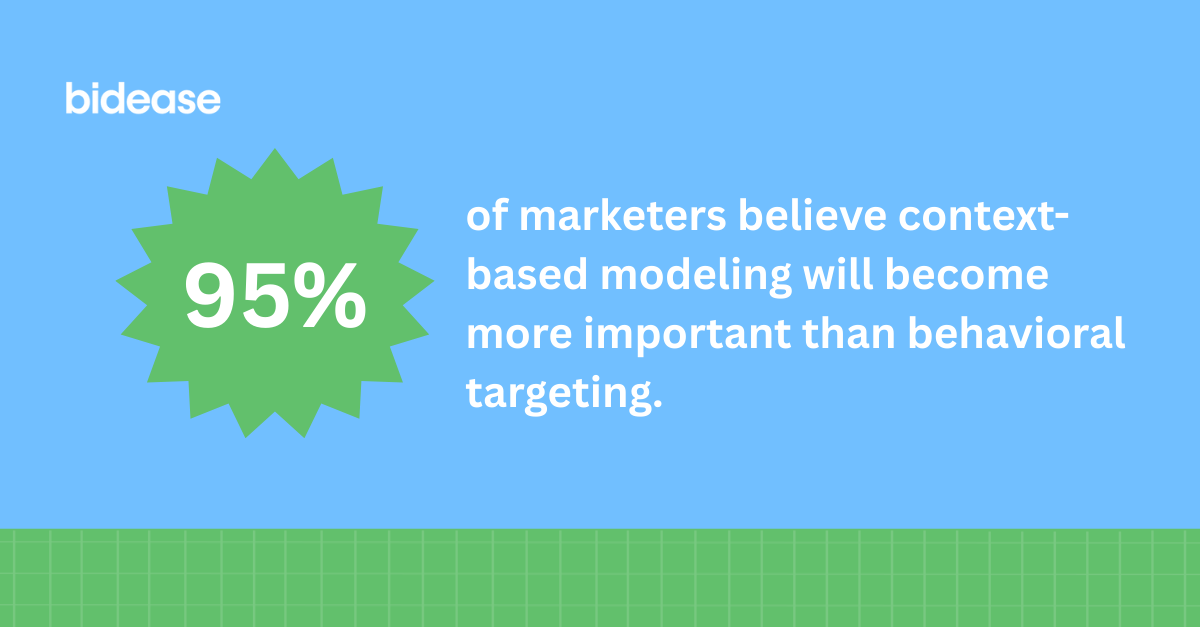
Despite this split in execution, the philosophical consensus is overwhelming. 95% of growth marketers agree that predictive modeling based on context and intent signals will become more important to their strategy than historical behavioral targeting over the next three years.
However, predictive targeting, in the context of time-sensitive micro moments, fails without predictive ad creative. If a model predicts a spike in "Neo-Deco" interest, but the brand takes three weeks to design and traffic a Neo-Deco ad, the micro-moment is lost. This is where dynamic creative feeds become the bridge between data and experience.
In this trend-led model, ad creatives are not static assets; they make up a liquid framework. Designers create a "shell" or template where elements like background colors, headlines, and product images are variables populated by a live data feed.
By feeding internal search query volume directly into a dynamic feed platform, brands can automate relevance. For instance, if internal search data shows a sudden velocity spike for "Cherry Red" dresses, the dynamic feed updates the product image in active programmatic banners to feature red inventory immediately without manual intervention.
Mining the "Internal Goldmine" of Intent
To replicate Pinterest's predictive success, brands must treat their own internal search bars not as navigational tools, but as predictive engines. Pinterest builds its trends by analyzing the velocity of specific queries (e.g., a sudden 55% spike in "blue drinks aesthetic" searches). Yet, for many marketers, this "internal goldmine" remains untapped due to operational lag.
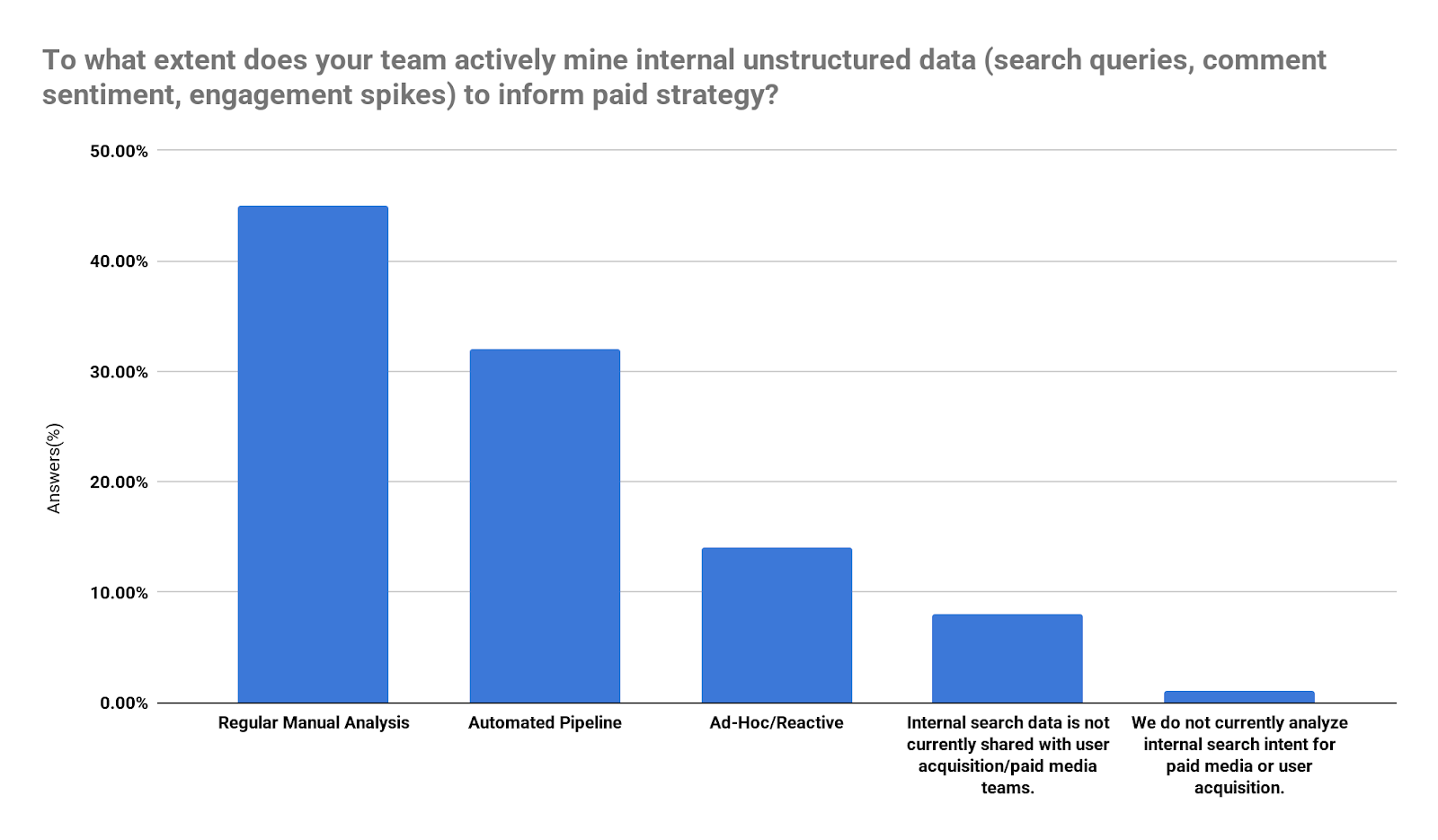
When asked about mining internal search queries and data, the majority of teams (45%) still rely on "Regular Manual Analysis" by reviewing logs weekly or monthly. Only 32% have achieved an "Automated Pipeline" that ingests real-time search intent directly into ad tech. In a world where trends, like "Gimme Gummy" as seen on Pinterest, can spike and saturate in weeks, a monthly manual review is too slow. The winners are the teams that can operationalize search velocity into immediate bid adjustments.
Operationalizing the Hybrid Model
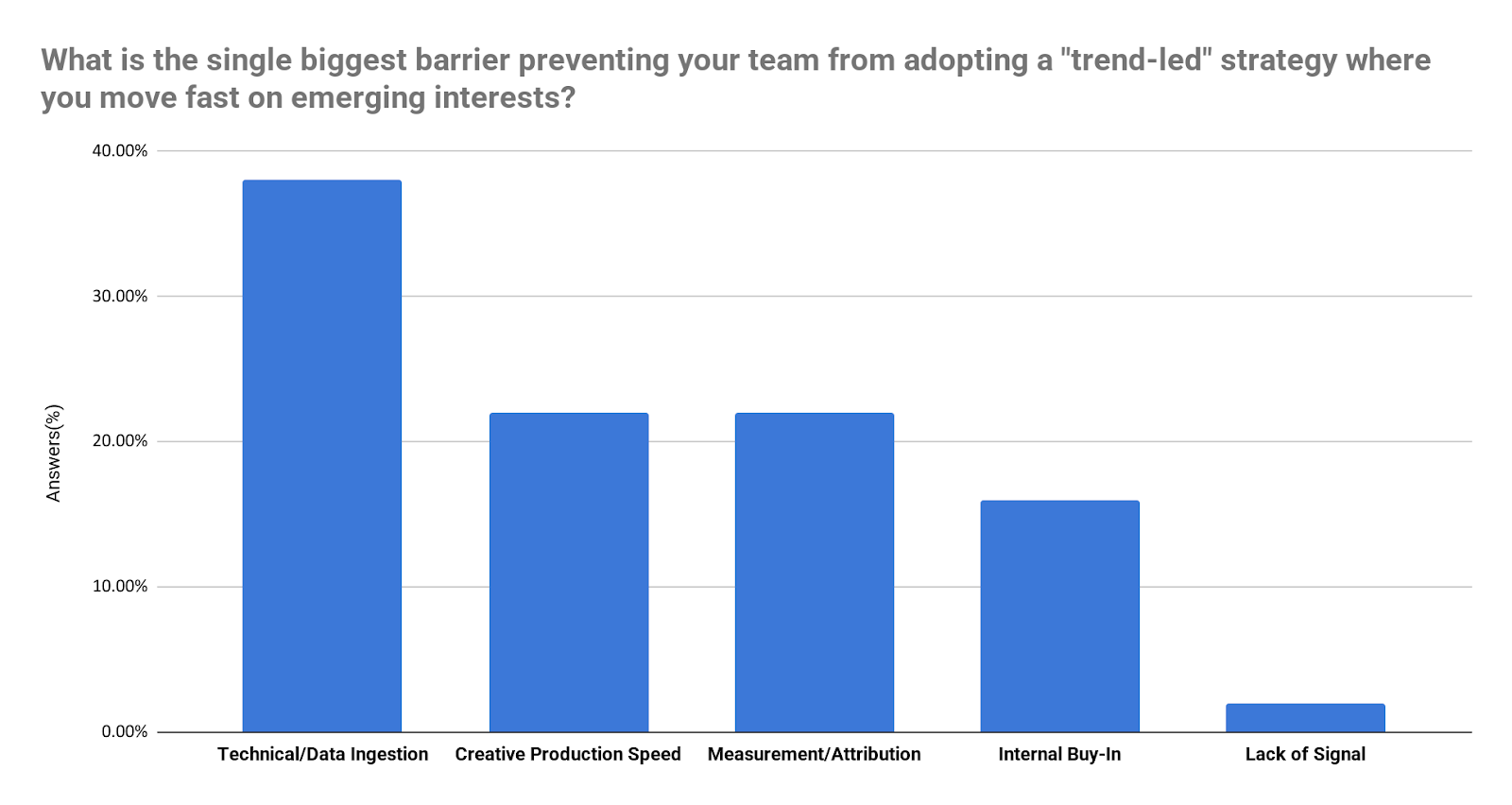
Despite the clear value of micro-moments, execution is hindered by infrastructure. The primary barrier preventing teams from adopting "trend-led" strategies is not a lack of creative ideas, but Technical/Data Ingestion (38%). Teams simply lack the pipes to feed live signals like weather APIs or viral coefficients into their bidding logic.
To bridge this gap, sophisticated teams are turning to advanced DSPs that enable them to take advantage of micro-moments. While there’s a lot of variety, the architecture generally follows this flow:
1. The Listening Stage (The Signal Source)
Think of this as the "ears" of your campaign. This is simply where the information comes from.
- Weather: Is it raining, snowing, or sunny right now? (Using basic weather apps).
- Trends Data: What is everyone talking about online? Is there a sudden spike in searches for a specific topic on TikTok or Google?
- Internal Data: What are customers searching for inside your specific app?
2. The Translating Stage (The Intelligent DSP)
This is the "brain" of the operation, and it’s the part most teams are missing. A sophisticated DSP ingests raw signals directly and feeds them into its own Machine Learning core.
- What it does: The DSP uses AI to calculate probability, rather than just following simple “If/Then” rules.
- The Logic: It takes the signal ("It is cool and sunny") + the user’s history ("They like hiking") + the trend ("Hiking boots are viral") and calculates the exact probability of a conversion in that specific moment. It doesn't just read the data; it understands the value of the data.
3. The Decision Layer (Smart Execution)
This is where the DSP moves from "prediction" to "action" in milliseconds. It isn't just a middleman buying ad space; it is an active decision-maker.
- Dynamic Pricing: The DSP automatically determines the perfect bid price. It knows that right now, this user is worth 3x more because the weather and the trend have aligned.
- Creative Selection: At the same time, it chooses which ad to show and then bids on the impression. The algorithms instantaneously select the "Hiking Boot" ad creative over the "Sandal" creative, ensuring the message matches the moment perfectly.
To summarize, the gap isn't a lack of data, but a lack of native intelligence in the buying platform. Most teams failing to capture micro-moments are stuck with legacy DSPs that treat weather or viral trends as irrelevant data, requiring complex external middleware to translate them. The solution is to upgrade the engine. If that’s the situation you’re in, Bidease’s predictive solutions might be the right option for you.
The open-ended responses in our survey regarding which external signal teams would integrate "instantly" highlight the demand for this type of infrastructure. "Live Weather" and "TikTok Viral Coefficients" were the most requested signals. Respondents explicitly stated why these were valuable insights: "Live weather data, because weather has a direct and immediate impact on consumer demand" and "TikTok viral coefficients because... it’ll boost traffic." This confirms that marketers know what they want to ingest; the barrier is the how.
The Future is Contextual
The winners of 2026 will be the teams that can operationalize context as fast as they operationalize clicks. Our data confirms that the industry is ready to move: 44% of teams already describe their approach as "Proactive/Predictive," launching net-new creative concepts to anticipate trends rather than waiting for users to engage first.
Achieving this level of precision requires an acquisition partner that doesn't just deliver impressions, but identifies the high-intent micro-moments that drive conversion. Bidease leverages proprietary neural networks to find and acquire your most valuable customers across the mobile ecosystem. By analyzing real-time signals through our neural networks, we acquire the exact right person at the precise micro-moment they’re ready to engage, removing the guesswork from mobile growth. Contact us today for a free consultation with our growth experts.

Customer retention is the key
Lorem ipsum dolor sit amet, consectetur adipiscing elit lobortis arcu enim urna adipiscing praesent velit viverra sit semper lorem eu cursus vel hendrerit elementum morbi curabitur etiam nibh justo, lorem aliquet donec sed sit mi dignissim at ante massa mattis.
- Neque sodales ut etiam sit amet nisl purus non tellus orci ac auctor
- Adipiscing elit ut aliquam purus sit amet viverra suspendisse potent
- Mauris commodo quis imperdiet massa tincidunt nunc pulvinar
- Excepteur sint occaecat cupidatat non proident sunt in culpa qui officia
What are the most relevant factors to consider?
Vitae congue eu consequat ac felis placerat vestibulum lectus mauris ultrices cursus sit amet dictum sit amet justo donec enim diam porttitor lacus luctus accumsan tortor posuere praesent tristique magna sit amet purus gravida quis blandit turpis.

Don’t overspend on growth marketing without good retention rates
At risus viverra adipiscing at in tellus integer feugiat nisl pretium fusce id velit ut tortor sagittis orci a scelerisque purus semper eget at lectus urna duis convallis porta nibh venenatis cras sed felis eget neque laoreet suspendisse interdum consectetur libero id faucibus nisl donec pretium vulputate sapien nec sagittis aliquam nunc lobortis mattis aliquam faucibus purus in.
- Neque sodales ut etiam sit amet nisl purus non tellus orci ac auctor
- Adipiscing elit ut aliquam purus sit amet viverra suspendisse potenti
- Mauris commodo quis imperdiet massa tincidunt nunc pulvinar
- Adipiscing elit ut aliquam purus sit amet viverra suspendisse potenti
What’s the ideal customer retention rate?
Nisi quis eleifend quam adipiscing vitae aliquet bibendum enim facilisis gravida neque euismod in pellentesque massa placerat volutpat lacus laoreet non curabitur gravida odio aenean sed adipiscing diam donec adipiscing tristique risus amet est placerat in egestas erat.
“Lorem ipsum dolor sit amet, consectetur adipiscing elit, sed do eiusmod tempor incididunt ut labore et dolore magna aliqua enim ad minim veniam.”
Next steps to increase your customer retention
Eget lorem dolor sed viverra ipsum nunc aliquet bibendum felis donec et odio pellentesque diam volutpat commodo sed egestas aliquam sem fringilla ut morbi tincidunt augue interdum velit euismod eu tincidunt tortor aliquam nulla facilisi aenean sed adipiscing diam donec adipiscing ut lectus arcu bibendum at varius vel pharetra nibh venenatis cras sed felis eget.
Related articles
Browse all articles


Let's Talk
We're Here to Help
Start your free consultation today. Create a custom growth strategy with a Bidease specialist.