
The CPI Come-Down: What Happens After Peak Season Ends
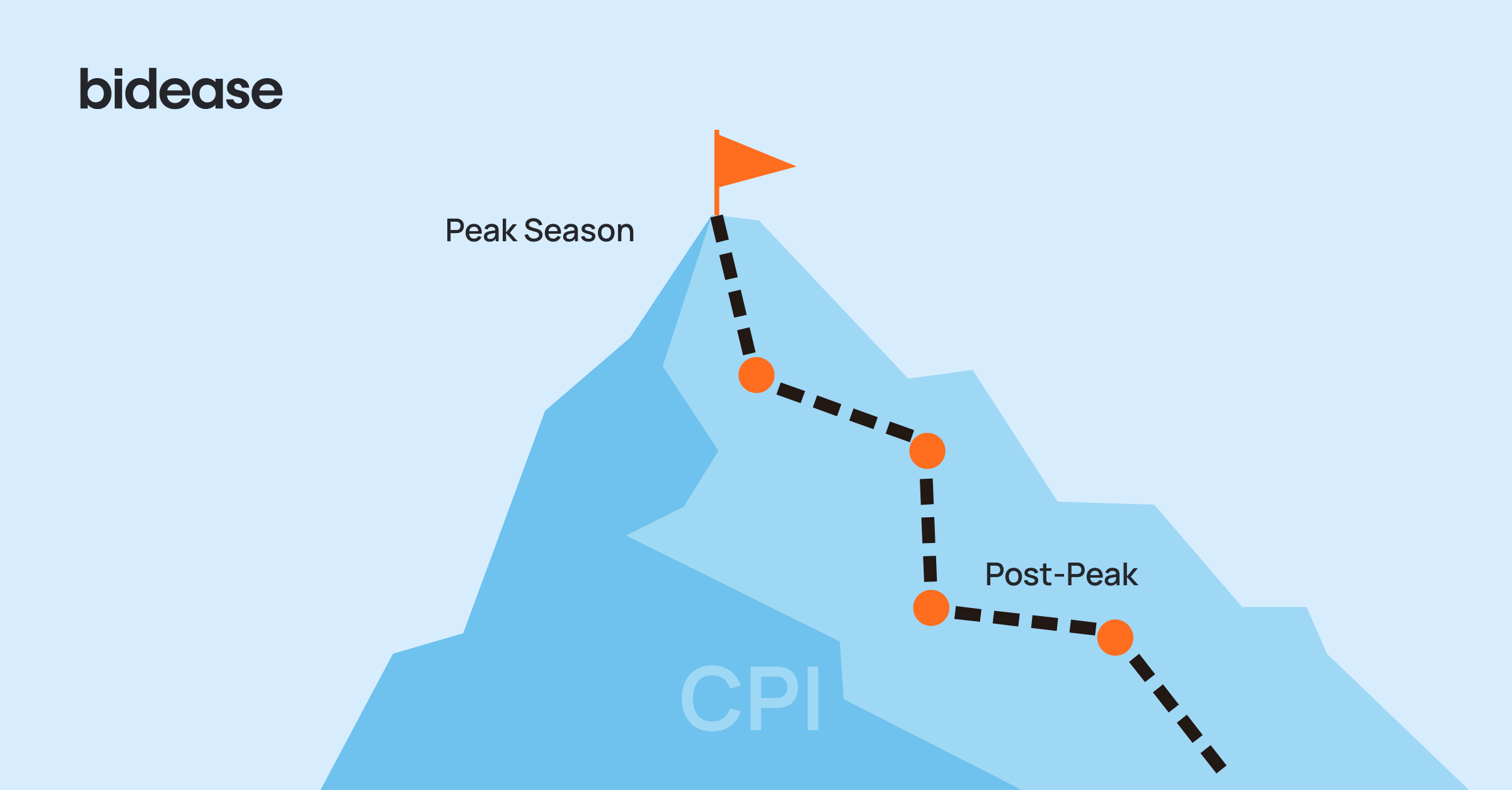

Peak season always ends the same way.
Budgets pull back. Competition softens. Dashboards start to calm down. And UA teams everywhere ask a familiar question: where do CPIs actually normalize first, and where do they stay elevated longer than expected?
While CPIs almost always decline after Q4, they don’t fall evenly across markets or app categories. Some regions reset quickly as demand drops out of the auction, while others unwind slowly as large advertisers taper spend over weeks, not days.
App category matters just as much. Gaming, retail, fintech, and streaming all follow very different post-peak rhythms.
Understanding these patterns helps UA teams avoid two common mistakes: re-entering auctions too early while competition is still inflated, or waiting too long and missing the most efficient windows to test and scale in Q1.
Bidease researched where CPIs typically normalize fastest after peak season, and broke down the results so app marketers can use these dynamics to plan smarter post-peak strategies.
What CPI “Normalization” Looks Like
When marketers talk about CPIs normalizing, they don’t mean costs instantly return to their lowest point of the year. In practice, normalization shows up more subtly.
It starts when auction pressure stabilizes and daily volatility decreases. Win rates become more predictable. Frequency curves flatten. Incremental spend begins to produce consistent results again instead of diminishing returns. In programmatic environments especially, these signals often appear before headline CPIs visibly drop.
That’s why timing matters. Teams that wait for perfect-looking benchmarks often miss the early efficiency window, while those watching underlying auction dynamics tend to move sooner and with more confidence.
How CPIs Normalize by Region
Latin America: Fast Reset, Early Opportunity
Latin America is often one of the fastest regions to normalize after peak season.
Holiday demand in LATAM is heavily influenced by global advertisers rather than sustained local spend. Once international retail, gaming, and subscription brands pull back budgets in early January, auction pressure typically eases quickly. As a result, CPIs tend to stabilize earlier than in many Tier-1 markets.
For UA teams, this often creates an early Q1 opportunity. LATAM can be a strong region for controlled scaling, testing new creatives, or reintroducing campaigns that were priced out during Q4.
The tradeoff is that volume can fluctuate. Efficiency improves quickly, but sustained scale still requires careful pacing and monitoring.
Southeast Asia: Fast for Gaming, Uneven Elsewhere
Southeast Asia often sees rapid post-peak normalization in gaming and entertainment categories, where holiday-driven demand fades quickly once promotions end. In contrast, utility and fintech apps can remain competitive longer due to consistent performance-driven budgets.
This uneven cooldown means CPIs normalize at different speeds even within the same region. A gaming app may see efficiency improve within weeks, while a finance app experiences a slower, more gradual decline.
North America: Slower, More Gradual Decline
North America typically takes slightly longer to normalize after peak season.
Large advertisers rarely exit the auction all at once. Brand budgets unwind gradually, subscription apps continue to chase New Year intent, and performance marketers often maintain spend into January to capture demand momentum in what is commonly referred to as “Q5.”
As a result, CPIs usually decline steadily rather than sharply. True efficiency gains often emerge later in Q1, once brand pressure fully clears and performance budgets recalibrate.
For UA teams, early January can still feel expensive, while late January and February often offer more stable opportunities to scale.
Western Europe: Normalization Depends on Category and Country
Western Europe sits somewhere between LATAM and North America.
Retail and e-commerce apps tend to see CPIs normalize relatively quickly once holiday shopping ends. In contrast, finance, travel, and subscription apps often maintain pressure longer, especially in core markets.
Local holidays, country-specific buying behavior, and regional budget cycles play a larger role here than in other regions. Treating Western Europe as a single market often leads to missed opportunities or mistimed scale.
MENA: Less Predictable, Sometimes Counter-Cyclical
MENA does not always follow global peak-season patterns.
In some markets, CPIs improve post-Q4 as global advertisers pull back and regional demand remains steady. In others, performance shifts depend heavily on device mix, local adoption cycles, and vertical-specific behavior.
Timing for Eid and Ramadan also play an important role. In 2026, Ramadan is expected to start earlier than usual, around February 17. This means that while competition may soften slightly at the beginning of January, CPIs may not “normalize” but spike again as spend on Ramadan advertising increases. E-commerce and payment apps tend to see the steepest competition during this season.
How CPI Normalization Varies by App Category
Gaming: Fast Cooldown, Short Windows
Gaming CPIs often normalize faster than most categories after peak season, especially in casual and mid-core games. Holiday-driven demand drops off quickly, reducing competition in the auction.
However, gaming CPIs also rebound fast once new launches, live ops events, and updates resume. The result is a narrow window where efficiency improves before competition returns.
Speed matters here. Teams that move quickly tend to benefit most.
E-commerce and Retail: Sharp Drop, Shorter Intent
Retail CPIs typically fall quickly once holiday shopping ends (the exception is in MENA this year, with Ramadan starting early). Competition eases, but user intent also drops, which can limit scale even as efficiency improves.
This makes early Q1 better suited for efficiency-focused campaigns rather than aggressive growth, especially for non-essential retail apps.
Fintech and Utilities: Stable, Slower Shifts
Fintech and utility apps usually see less dramatic CPI swings overall. Budgets are often tied to ongoing acquisition goals rather than seasonal spikes, which keeps competition relatively steady.
Normalization happens, but it’s subtle. Gains come from consistency rather than sudden drops in cost.
Entertainment and Streaming: Prolonged Competition
Streaming and entertainment apps often maintain elevated spend into Q1, driven by content releases and subscription cycles. As a result, CPIs tend to normalize more slowly, particularly in Tier-1 markets.
Efficiency improves gradually, rewarding steady optimization over sudden budget shifts.
Putting This Into Practice for Q1 Planning
The biggest mistake UA teams make after peak season is assuming CPI normalization happens everywhere at the same time.
A more effective approach is staggered re-entry. Fast-normalizing regions can be tested early with controlled budgets, while slower markets are monitored until auction pressure meaningfully declines. Watching win rates, frequency, and marginal returns often provides clearer signals than waiting for headline CPIs alone.
Teams that treat Q1 as a calibration period rather than an immediate scale moment consistently uncover stronger efficiency later in the quarter.
Coming Down from the Peak
Peak season doesn’t end when the calendar flips. Instead, it ends when auction pressure begins to subside.
Knowing which apps recover quickly after peak season — and which require more caution — helps UA marketers plan smarter Q1 budgets. Managing these transitions effectively requires both responsive technology and close human oversight. Bidease adapts bidding and pacing as CPIs shift throughout the day with leading AI technology, while our media buying teams actively monitor seasonal patterns that impact performance. Together, this approach helps campaigns scale steadily without overreacting to short-term volatility.
If you want to deliver a smooth cool-down transition and successful Q1 results, connect with Bidease today to schedule a free growth consultation.

Customer retention is the key
Lorem ipsum dolor sit amet, consectetur adipiscing elit lobortis arcu enim urna adipiscing praesent velit viverra sit semper lorem eu cursus vel hendrerit elementum morbi curabitur etiam nibh justo, lorem aliquet donec sed sit mi dignissim at ante massa mattis.
- Neque sodales ut etiam sit amet nisl purus non tellus orci ac auctor
- Adipiscing elit ut aliquam purus sit amet viverra suspendisse potent
- Mauris commodo quis imperdiet massa tincidunt nunc pulvinar
- Excepteur sint occaecat cupidatat non proident sunt in culpa qui officia
What are the most relevant factors to consider?
Vitae congue eu consequat ac felis placerat vestibulum lectus mauris ultrices cursus sit amet dictum sit amet justo donec enim diam porttitor lacus luctus accumsan tortor posuere praesent tristique magna sit amet purus gravida quis blandit turpis.

Don’t overspend on growth marketing without good retention rates
At risus viverra adipiscing at in tellus integer feugiat nisl pretium fusce id velit ut tortor sagittis orci a scelerisque purus semper eget at lectus urna duis convallis porta nibh venenatis cras sed felis eget neque laoreet suspendisse interdum consectetur libero id faucibus nisl donec pretium vulputate sapien nec sagittis aliquam nunc lobortis mattis aliquam faucibus purus in.
- Neque sodales ut etiam sit amet nisl purus non tellus orci ac auctor
- Adipiscing elit ut aliquam purus sit amet viverra suspendisse potenti
- Mauris commodo quis imperdiet massa tincidunt nunc pulvinar
- Adipiscing elit ut aliquam purus sit amet viverra suspendisse potenti
What’s the ideal customer retention rate?
Nisi quis eleifend quam adipiscing vitae aliquet bibendum enim facilisis gravida neque euismod in pellentesque massa placerat volutpat lacus laoreet non curabitur gravida odio aenean sed adipiscing diam donec adipiscing tristique risus amet est placerat in egestas erat.
“Lorem ipsum dolor sit amet, consectetur adipiscing elit, sed do eiusmod tempor incididunt ut labore et dolore magna aliqua enim ad minim veniam.”
Next steps to increase your customer retention
Eget lorem dolor sed viverra ipsum nunc aliquet bibendum felis donec et odio pellentesque diam volutpat commodo sed egestas aliquam sem fringilla ut morbi tincidunt augue interdum velit euismod eu tincidunt tortor aliquam nulla facilisi aenean sed adipiscing diam donec adipiscing ut lectus arcu bibendum at varius vel pharetra nibh venenatis cras sed felis eget.
Related articles
Browse all articles
Let's Talk
We're Here to Help
Start your free consultation today. Create a custom growth strategy with a Bidease specialist.