
The AI Capability Gap: Benchmarking How Mobile Growth Teams Are Upskilling

As part of our ongoing research into how app marketers adapt to an evolving landscape of technology, data, and strategy, Bidease surveyed 100 UA marketers to uncover what’s really changing behind the scenes. Each post in this series highlights one insight shaping the future of programmatic growth, straight from the marketers driving it.
Ask any marketing team today who is using AI, and almost every hand will go up. But this ubiquity has created an era where teams equate accessing a tool with wielding a capability.
The reality is that only a fraction of AI users are actually building proprietary, repeatable workflows that drive compounded performance lift. Most marketing teams are still engaging with LLMs at a rudimentary level, relying on them merely to draft copy or rewrite emails. The teams that win have evolved beyond this easy adoption. They understand that a lasting advantage isn't built on flashy prompts, but forged in the behind-the-scenes effort of constructing shared knowledge bases, meticulously tracking what doesn't work, and pushing AI for high stakes tasks.
We surveyed 100 growth marketers to learn how they are aggressively upskilling to tackle these higher-stakes tasks, the structural bottlenecks they face along the way, and the operational results they are seeing.
Closing the Time Investment Gap
Companies are eager to buy SaaS subscriptions but reluctant to budget the time required to learn them. For years, the operational reality of upskilling was relegated to "nights and weekends," creating a massive disconnect between leadership expectations ("use AI to go faster") and employee bandwidth.

Fortunately, we are seeing a major shift. Today, 45% of companies explicitly allocate "Structured Allocation" (dedicated lab time) for AI upskilling, making it the dominant learning style over "Ad-Hoc Permission" (32%). Only 18% of teams are still forced to figure it out on their own time.
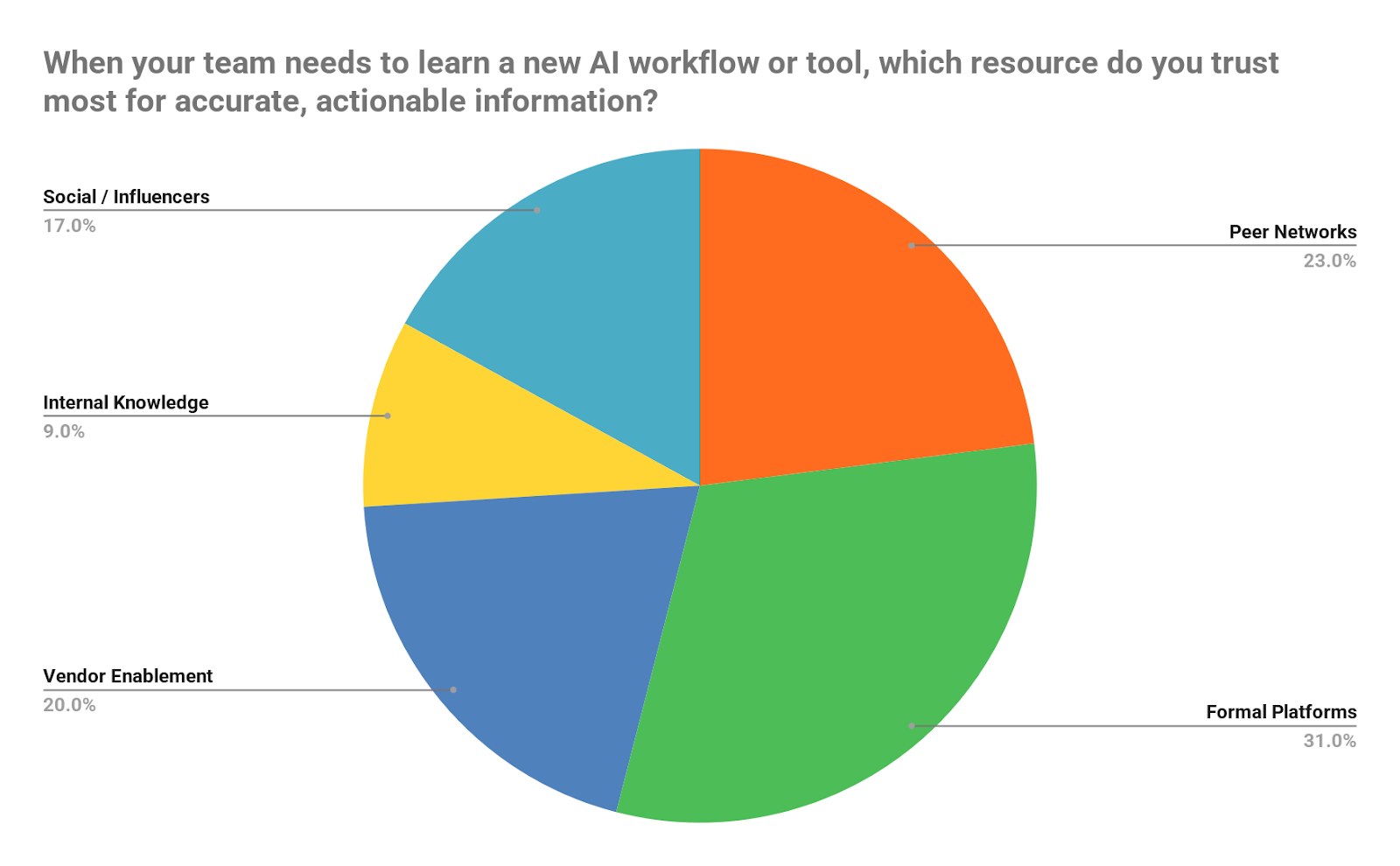
But where are teams developing these skillsets during this employer-allocated time? We’re witnessing a surge in "Learn How to Wield AI" courses, and trust is shifting from peers to pros. While "Formal Platforms" (e.g., Coursera, Reforge) hold a slight lead at 31%, the rest of the attention is relatively evenly split across peer networks(23%), vendor enablement (20%), and social media (17%). Rather than completely moving beyond the surface-level hacks shared on LinkedIn, teams are currently balancing those fragmented tips with structured curricula from professional teachers and the AI vendors themselves. This signals a professionalization of the space.
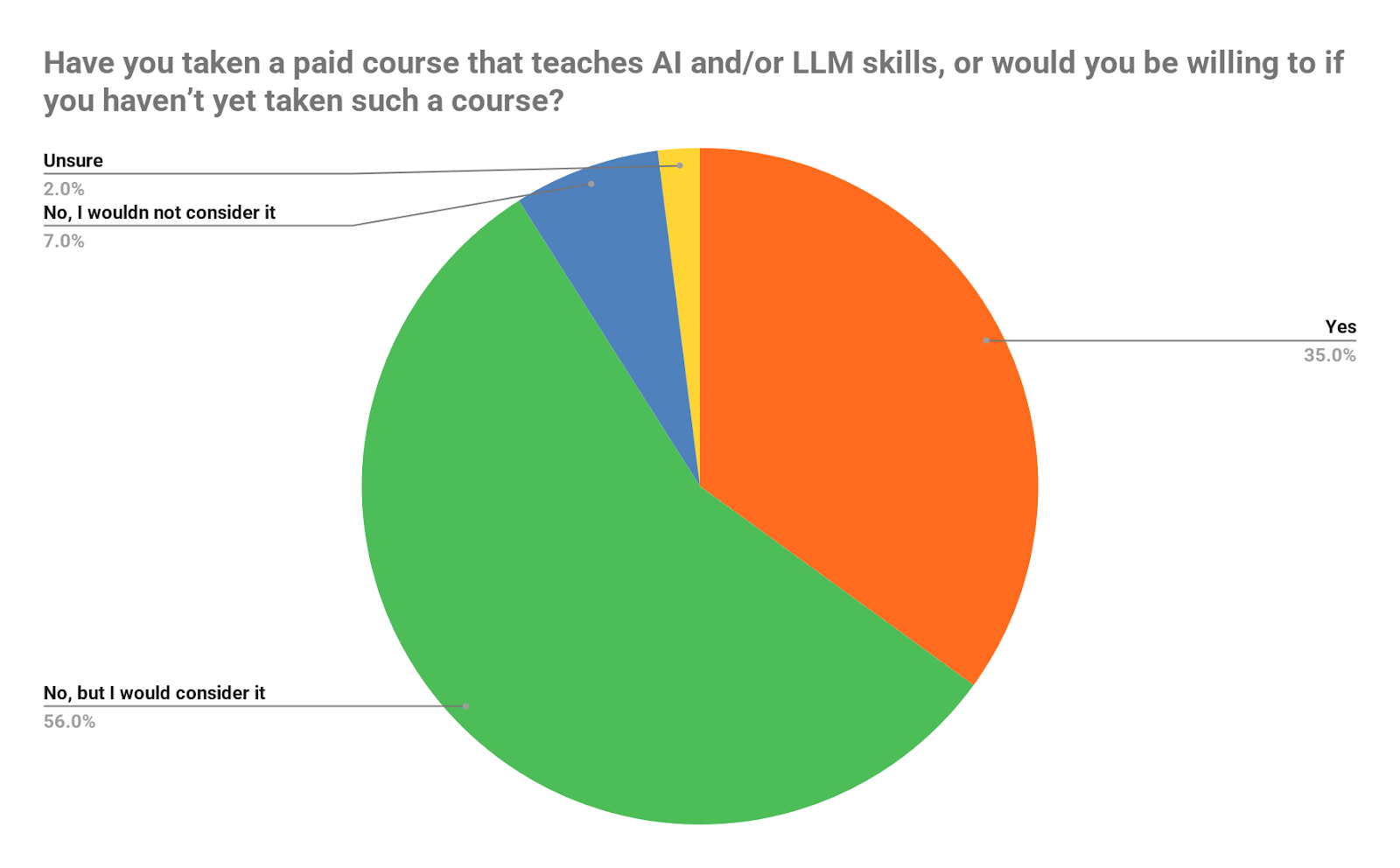
Yet, a massive gap remains: 56% of respondents haven't taken a paid course but would consider doing so. This represents the majority of the market. Many growth marketers use AI daily and trust formal platforms, but haven't yet pulled the trigger on structured education to bridge their knowledge gap.
It then falls to leadership teams to take advantage of this willingness to learn. To harness it properly, carve out structured allocation time where growth marketers can focus on developing their skillsets with AI tools. Investing even a small amount of budget into paid courses can pay dividends in the long run.
This structured learning time shouldn't just be spent consuming content. It must be paired with the unglamorous work of building internal prompt libraries and shared repositories, ensuring that every new skill learned by an individual is permanently captured for the rest of the team.
The Creative Safety Zone
To pressure-test actual proficiency, we have to look at where AI is being deployed. The data proves that "high adoption" is mostly inflated by low-value, low-risk tasks.
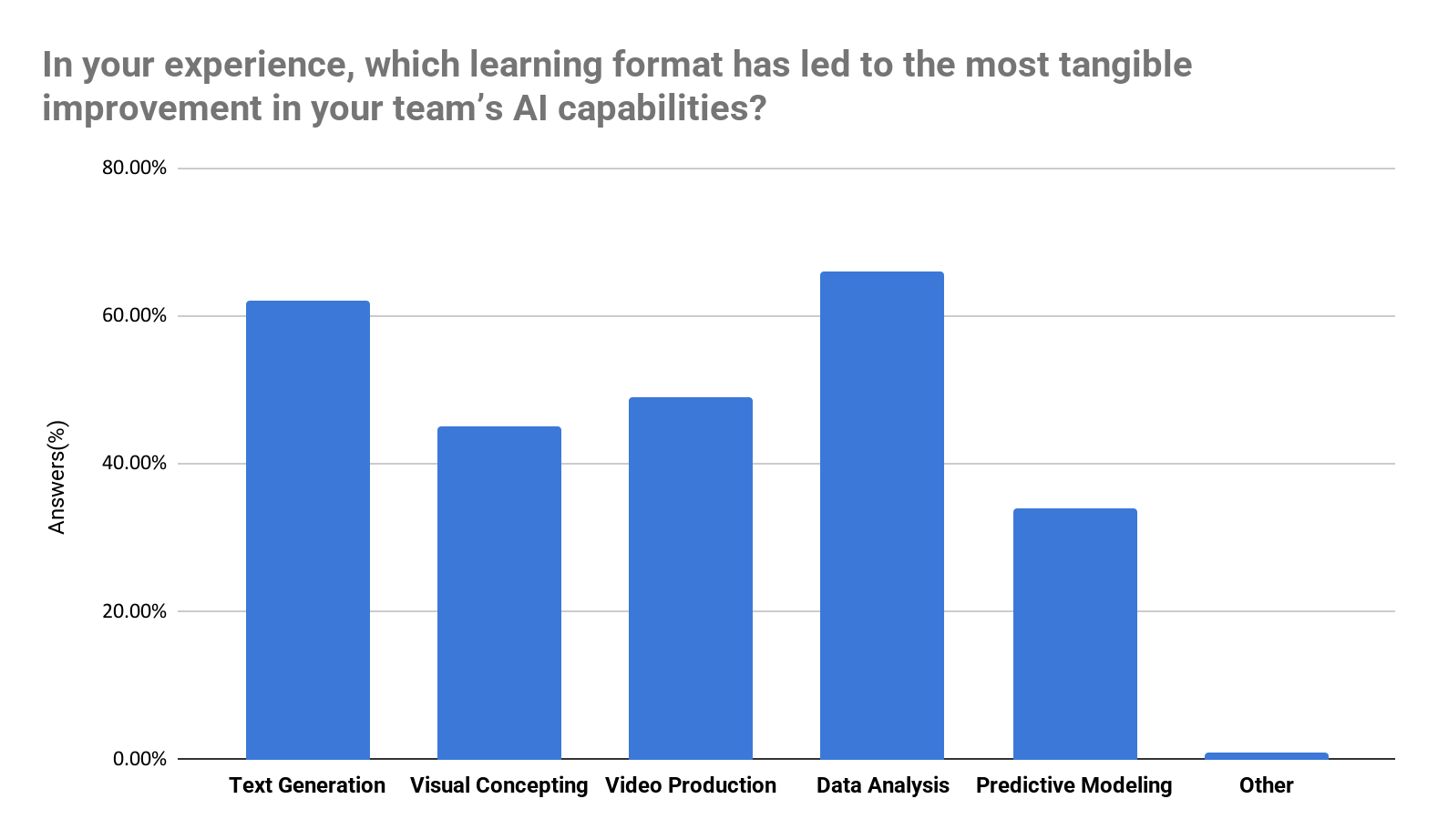
Currently, teams feel highly confident using LLMs for simple tasks like Text Generation (62% have a documented workflow) and Visual Concepting (45%). Why? Because the cost of failure is remarkably low. A bad headline is annoying; a bad data model is fatal.
We are seeing an emerging middle ground where growth teams move from just chatting with an LLM to building autonomous workflows, but there’s a massive void for deep work tasks. While a surprising 66% of growth marketing teams use AI for data analysis, only 34% have a workflow for predictive modeling.
This is where the mirage crumbles. The problem isn't that marketers don't want this capability. In fact, when we asked what skill they would instantly upload into their team's brain, open-ended responses heavily favored "Instant Coding" and "Predictive Data Analysis." Quotes like "A data analysis tool that predicts what our clients really care about" highlight that growth teams desperately view AI as a way to bypass their own technical bottlenecks.
The real issue is twofold: teams don't know how to build these forecasting models themselves, and more importantly, they worry about the risk. Marketers are comfortable using AI to clean data, but they hesitate to trust it with high-stakes forecasting. When predictive AI fails in the real world, the results can be catastrophic. Just look at Zillow’s iBuying program: their proprietary AI valuation algorithm failed to predict a cooling housing market and kept making aggressive above-market offers, resulting in a massive $500 million write-down and the layoff of 25% of their workforce.
As noted in our analysis of Pinterest-style contextual intelligence, shifting from simple creative generation to predictive targeting is where teams really get an advantage. To reach that predictive tier safely, marketers must stop using AI simply to summarize the past. They need to work with their data analysts and AI-driven partners (like DSPs) to do the rigorous, behind-the-scenes work of training models securely on their proprietary data so they can forecast market shifts without exposing themselves to blind algorithmic disasters. But that means it’s essential to invest in upskilling their capabilities so they feel comfortable using AI tools for advanced tasks like budgeting and data analysis.
Integrating AI Into the Stack
Moving from low-level adoption to concrete operational reality requires identifying which specific tools power these workflows, a much clearer indicator of capability than self-reported maturity alone.
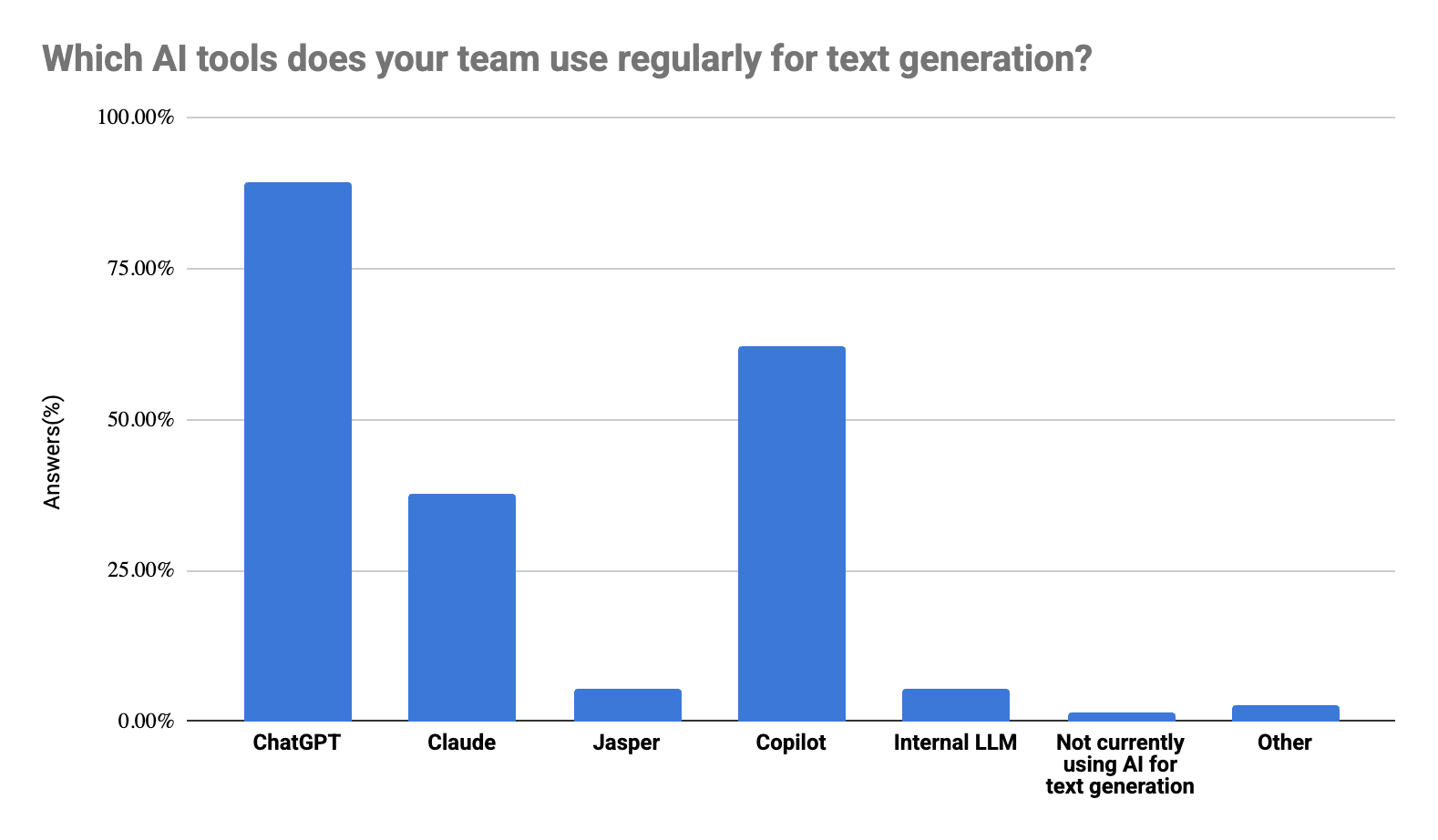
Our survey reveals a stark divide between creative and data tasks. For text generation, ChatGPT remains the top destination (used by 89% of teams), but Copilot’s strong second-place showing (62%) highlights the shifting demand for embedded AI. Marketers are realizing that switching between a Word document, opening a ChatGPT tab, copying, and pasting is a major friction point. The fact that legacy standalone tools like Jasper (5%) have been abandoned, while tools built seamlessly into daily B2B workflows thrive, proves that convenience is king. This embedded nature also likely explains the absence of tools like Grammarly from the top of the list. When AI is seamlessly baked into the background of a Google or Word document, people often stop perceiving it as a distinct "AI tool" they are choosing to use.

In visual concepting, Canva AI (69%) dominates, far outpacing high-fidelity tools like Midjourney (27%) and DALL-E (26%). This is about control over the tools just as much as it’s about the speed at which they operate. DALL-E has built a reputation for generating outputs that look distinctly "too AI." Conversely, tools like Canva (and likely Adobe Firefly, given its native integration into existing creative suites) allow marketers to lock in specific brand guidelines and hex codes, providing a level of brand safety and trust that unpredictable generative models lack.
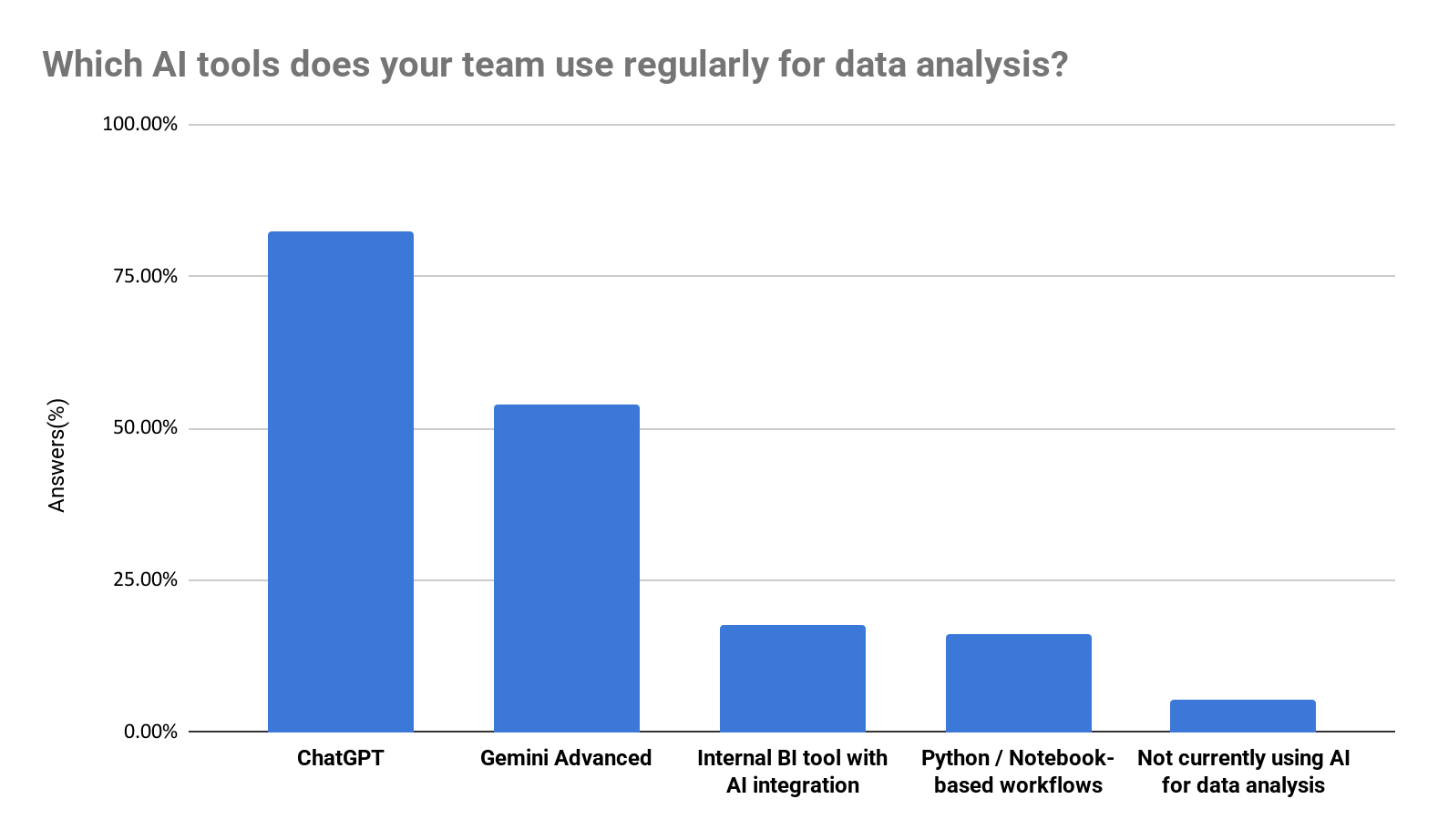
When it comes to data, an "Excel Enhancer" dynamic has officially arrived. While 82% of teams use ChatGPT to analyze data, they still fundamentally rely on Google Sheets and Excel to house that information. However, true stack integration remains elusive. Only 18% use an internal BI tool with AI integration, and just 16% use Python/Notebook-based workflows. This low number is likely an economic calculation. Rather than spending engineering resources to build a custom, less-successful internal BI tool, teams find it much easier to simply pay for a Google Workspace subscription to use Gemini directly inside Sheets.
When we asked marketers what skill they would instantly upload into their team's brain, the answers were telling. Instead of more creative brainstorming, they want technical leverage. Open-ended responses heavily favored "Instant Coding" and "Predictive Data Analysis," with specific requests for skills like "Python scripting for web optimization." As one respondent put it, the goal is "AI powered decision intelligence, because better decisions create more impact than faster execution." This highlights a desire to do the hard math, but a lack of bridges to get there.
If your AI usage lives entirely in disconnected tools like the ChatGPT web app, your team's capability cannot compound. To fix that, marketing teams must force true stack integration by prioritizing the connection of LLMs directly into your existing business intelligence systems, creative testing loops, or building AI agents. Doing so allows the team to move beyond experimentation into execution.
Auditing Friction Points
If the mandate is to master tools, what is stopping app marketers? We surveyed growth teams to identify the structural barriers preventing deep capability building.
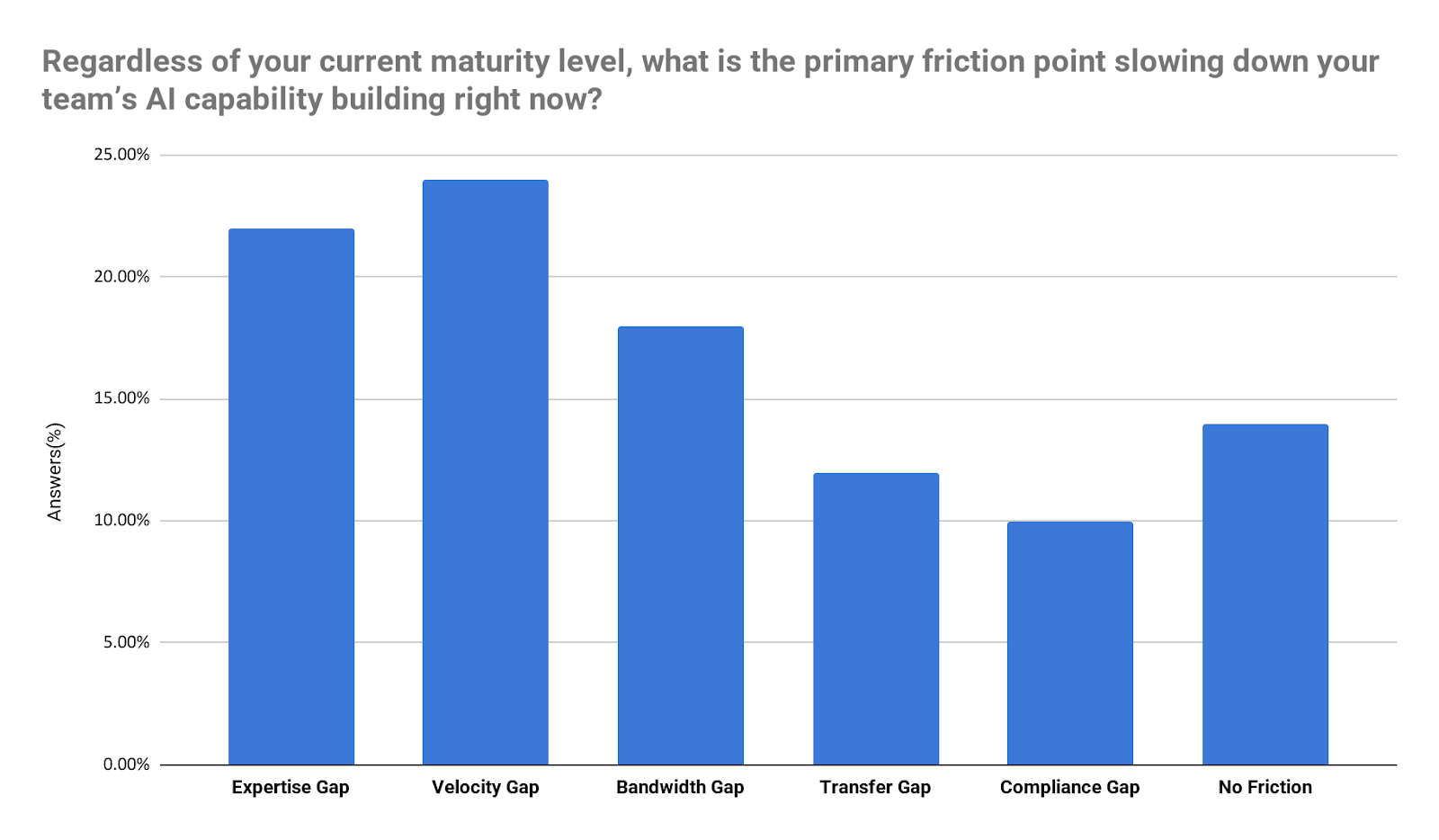
Historically, the assumption was that growth teams simply lacked the time (the "Bandwidth Gap"). However, only 18% of respondents cited bandwidth as their primary friction point. The real blockers are external.
The "Velocity Gap" took the top spot (24%). Technology is changing so fast that workflows and skills become obsolete before teams can standardize them. This was followed closely by the "Expertise Gap" (22%). Teams have mastered the basics of prompting, but they are hitting a ceiling because advanced, role-specific training for mobile growth simply doesn't exist yet. Furthermore, a persistent Quality/Execution gap remains: teams don’t always believe LLMs can produce high-quality output without heavy human intervention, limiting their willingness to invest in complex training.
While teams may lack bridges now, it’s certainly possible to achieve these goals with a bit of effort. Stop hosting basic prompt engineering workshops for copywriting, and instead train your marketing team on how to use AI for data analysis and complex math.
To combat this rapid pace of technological change, you have to lean into unglamorous work. Mandate a team-wide 'failure log' where marketers rigorously document what doesn't work. By cataloging broken workflows and hallucinated outputs, you turn wasted cycles into a highly valuable, standardized database of institutional knowledge that outlasts any single software update.
Investing in the Human OS
The AI "Mirage" is dangerous because it looks like progress. Having your entire team use ChatGPT to write ad copy feels like innovation, but it’s simply not an edge in 2026. True advantage comes from building internal libraries, failure logs, and leveraging AI models to be at the forefront of trends.
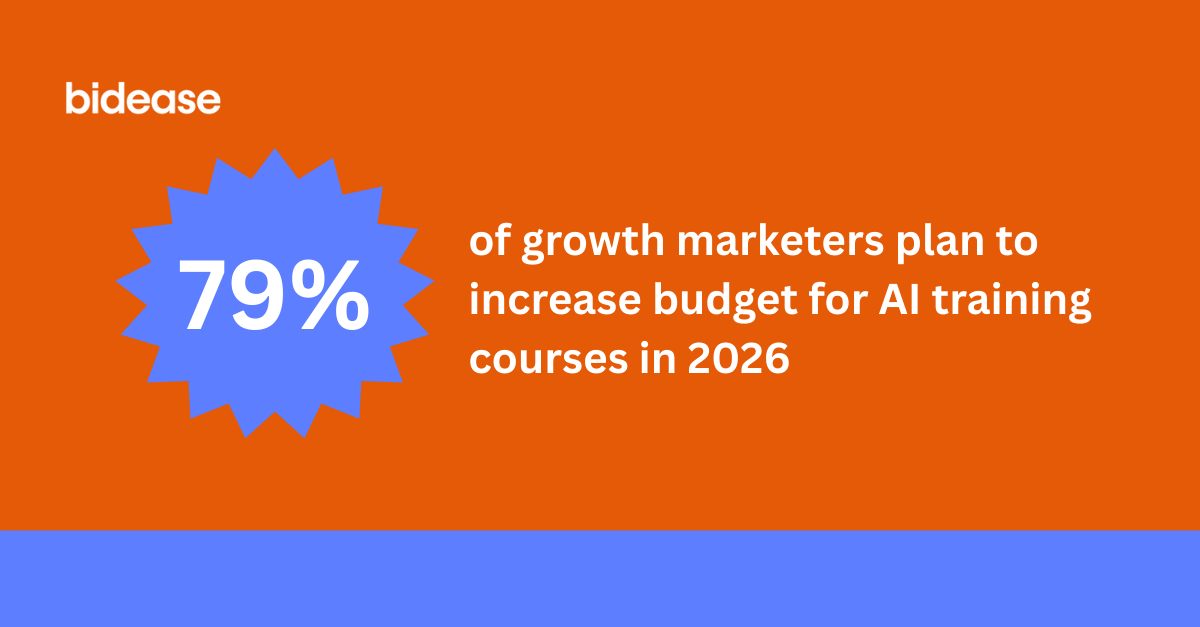
The good news is that the industry consensus is absolute: a massive 79% of teams plan to increase their budget for AI training and enablement in 2026. But the most telling data point of our entire survey is this: 0% of respondents said they would focus their budget on hiring new "AI specialists” to replace their current teams.
For the last few years, the loudest narrative in the industry has been that AI is coming to eliminate marketing jobs. This 0% statistic shatters that apocalyptic mindset. It reveals that growth leaders understand AI is a force multiplier, not a UA marketer. A generative model lacks the nuanced understanding of human psychology, brand voice, and strategic context that a seasoned marketer possesses. Leaders aren't looking to replace their teams because they realize that knowing exactly what to ask the AI and how to apply its output is infinitely more valuable than raw technical prompting skills.
But to truly empower these app marketers, they have to move beyond the chat interface. Most teams are still treating AI as a glorified search engine or copywriter, but the actual frontier of technical leverage is Agentic AI.
Advanced marketing teams are no longer just prompting LLMs, but building personal AI agents to orchestrate multi-step, cross-platform workflows. For example, using automation platforms like Cursor, a marketer can build an AI agent that automatically detects a new lead in HubSpot, uses AI to research their company, drafts a highly personalized outreach email, and sends it to a Slack channel for a human to approve with one click. This is the advanced AI infrastructure where AI stops being a tool you talk to, and starts being a digital teammate that executes on your behalf.
The mandate for growth leaders is clear: shift a portion of your SaaS budget into enablement time. Build the Sandbox. Invest in your Human OS. Because when every company has the exact same AI, the only variable left to optimize is you.
But you don't have to build the underlying infrastructure from scratch. If your team is ready to integrate true predictive targeting into your stack, discover how Bidease’s AI-powered DSP can help you turn complex data into your ultimate competitive advantage. Contact us today.

Customer retention is the key
Lorem ipsum dolor sit amet, consectetur adipiscing elit lobortis arcu enim urna adipiscing praesent velit viverra sit semper lorem eu cursus vel hendrerit elementum morbi curabitur etiam nibh justo, lorem aliquet donec sed sit mi dignissim at ante massa mattis.
- Neque sodales ut etiam sit amet nisl purus non tellus orci ac auctor
- Adipiscing elit ut aliquam purus sit amet viverra suspendisse potent
- Mauris commodo quis imperdiet massa tincidunt nunc pulvinar
- Excepteur sint occaecat cupidatat non proident sunt in culpa qui officia
What are the most relevant factors to consider?
Vitae congue eu consequat ac felis placerat vestibulum lectus mauris ultrices cursus sit amet dictum sit amet justo donec enim diam porttitor lacus luctus accumsan tortor posuere praesent tristique magna sit amet purus gravida quis blandit turpis.

Don’t overspend on growth marketing without good retention rates
At risus viverra adipiscing at in tellus integer feugiat nisl pretium fusce id velit ut tortor sagittis orci a scelerisque purus semper eget at lectus urna duis convallis porta nibh venenatis cras sed felis eget neque laoreet suspendisse interdum consectetur libero id faucibus nisl donec pretium vulputate sapien nec sagittis aliquam nunc lobortis mattis aliquam faucibus purus in.
- Neque sodales ut etiam sit amet nisl purus non tellus orci ac auctor
- Adipiscing elit ut aliquam purus sit amet viverra suspendisse potenti
- Mauris commodo quis imperdiet massa tincidunt nunc pulvinar
- Adipiscing elit ut aliquam purus sit amet viverra suspendisse potenti
What’s the ideal customer retention rate?
Nisi quis eleifend quam adipiscing vitae aliquet bibendum enim facilisis gravida neque euismod in pellentesque massa placerat volutpat lacus laoreet non curabitur gravida odio aenean sed adipiscing diam donec adipiscing tristique risus amet est placerat in egestas erat.
“Lorem ipsum dolor sit amet, consectetur adipiscing elit, sed do eiusmod tempor incididunt ut labore et dolore magna aliqua enim ad minim veniam.”
Next steps to increase your customer retention
Eget lorem dolor sed viverra ipsum nunc aliquet bibendum felis donec et odio pellentesque diam volutpat commodo sed egestas aliquam sem fringilla ut morbi tincidunt augue interdum velit euismod eu tincidunt tortor aliquam nulla facilisi aenean sed adipiscing diam donec adipiscing ut lectus arcu bibendum at varius vel pharetra nibh venenatis cras sed felis eget.
Related articles
Browse all articles

Let's Talk
We're Here to Help
Start your free consultation today. Create a custom growth strategy with a Bidease specialist.